Add Row
Add Element
cropper
update
Jacks Commercial Real Estate, Inc.
Logo design for Jacks Commercial Real Estate, Inc.
update
Add Element
  • Home
  • Categories
    • Office Real Estate
    • Retail Real Estate
    • Industrial Real Estate
    • Hospitality & Multifamily
    • Real Estate Market Trends
    • Commercial Real Estate Investment & Development
    • Sustainability & Smart Buildings
    • Leasing Strategies & Tenant Relations
    • Property Management Best Practices
    • Other News
August 21.2025
2 Minutes Read

Why San Francisco's Office Projects Are Transforming the Cityscape

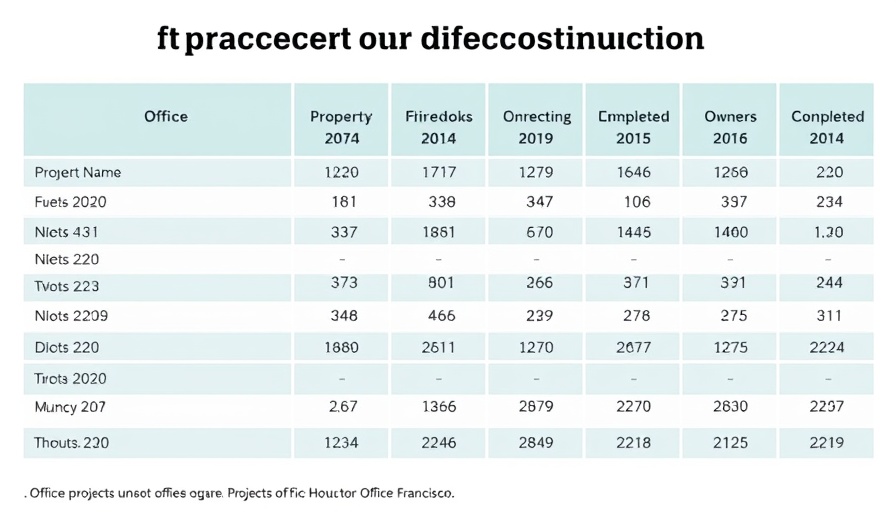
Table of office projects under construction in San Francisco with details like property names, square feet, owners, and completion dates.

Exploring San Francisco's Thriving Office Development Pipeline

As of mid-2025, San Francisco's office construction landscape is witnessing remarkable growth, with 2.1 million square feet of competitive office space currently under development. According to Yardi Research, this growth exceeds the national average, highlighting San Francisco's significance in the commercial real estate market.

Top Projects Shaping the Future

Among these developments, five projects stand out with a combined space of 1.4 million square feet. Notably, four of these initiatives cater to the life sciences sector, which has been seeing an influx of new spaces despite facing challenges of oversupply and rising vacancies. This sector's resilience and adaptability will be key to its success as it navigates these hurdles.

The Spur: Leading the Charge in Biotech

At the forefront of this growth is The Spur, a cutting-edge life science building located at 580 Dubuque Ave. Developed by IQHQ, this 330,300-square-foot facility received $275 million in construction financing. After topping out last year at eight floors, it is set to complete this year, marking an important milestone for the area's biotech ambitions. This development is crucial not only for enhancing San Francisco’s office landscape but also for expanding its foothold in the life sciences market.

Understanding the Bigger Picture: Life Sciences Demand

The burgeoning demand for life sciences real estate is undeniable, with over 43 million square feet delivered in recent years. However, as the sector prepares for increased vacancies, developers like IQHQ are seeking extensions and reevaluating their plans to sustain growth within this challenging climate. This anticipation of future market dynamics indicates a desire to adapt and remain competitive.

Concluding Thoughts

San Francisco's office construction scene is not just about raw numbers; it reflects a strategic vision for the future, especially in sectors that drive innovation and economic growth. As the city continues to evolve, it's apparent that these developments will play a pivotal role in shaping its commercial real estate landscape. With proactive management and strategic planning, San Francisco is poised to maintain its reputation as a leading hub for business and technology.

Commercial Real Estate Investment & Development

Write A Comment

*
*
Please complete the captcha to submit your comment.
Related Posts All Posts
04.16.2026

Exploring the Impact of Private Credit on Commercial Real Estate Stability

Update The Rise of Private Credit in Commercial Real EstateAmidst growing economic pressures and market volatility, investors are increasingly turning towards private credit as a means of diversifying their portfolios. As evident from recent trends, a significant shift is occurring, with many moving from traditional investments into real estate, viewing it as a more stable option during turbulent times.How Private Credit Could Influence Commercial Real EstateThe surge in popularity of private credit has caught the attention of commercial real estate (CRE) professionals. As reported, fluctuations in both local and global markets have led to increasing concerns regarding credit availability. With higher interest rates and the ongoing war in Iran adding pressure to the financial landscape, more investors are turning their gaze toward hard assets such as real estate as a viable outcome.Market Recovery and Investor ConfidenceAfter experiencing a downturn, where commercial real estate values dramatically declined by 22% from April 2022 to December 2023, signs of recovery are becoming apparent. Data from CoStar indicates a growing trend where capital is starting to flow back into real estate investment trusts (REITs), with non-traded, publicly registered REITs reporting strong fundraising numbers. The dynamics of investing seem to be shifting, with CRE likely to benefit from investors seeking stability amidst the raging uncertainty in the credit markets.What This Means for Future TrendsAs the private credit market faces scrutiny, it is clear that CRE may have great potential advantages. Many experts anticipate a continued influx of investments into real estate as traditional banks pull back, leaving a vacuum that private credit and real estate could fill. This evolving landscape may not only stabilize but potentially catalyze a new era in how CRE is viewed among investors. High-quality assets in prime locations are being recognized as sound investments in uncertain times, positioning real estate favorably in the ongoing economic narrative.

04.16.2026

Exploring the Flight to Safety: New Rules of Net Lease Investments

Update The New Era of Net Lease Investments As we traverse through 2026, the net lease investment landscape is transforming, driven predominantly by a significant "flight to safety" among investors. In an environment riddled with geopolitical uncertainty and economic volatility, wealthy private investors are now more than ever prioritizing stability over chaos, shifting their focus to net lease properties that are backed by strong credit profiles and solid market fundamentals. Understanding the Shift: Investor Behavior In this evolving market, private investors are rebuffing the high-risk strategies of yesteryear in favor of more conservative approaches. They are discerningly seeking out properties with corporate guarantees, long-term leases, and desirable locations that guarantee enduring income streams. Coupled with advanced AI-driven research tools, these investors can now delve into local market specifics with unprecedented depth, an essential evolution in decision-making. A Cautionary Tale: The Need for Discipline Despite the allure of certain assets, investors must tread with caution. The notion that "credit is king" could lead to missteps, as highlighted by the rapid decline of creditworthiness witnessed in brands like Walgreens. It’s imperative for investors to place weight on the underlying properties themselves, evaluating factors like rent levels and location, rather than solely relying on tenant ratings. This reflexive assessment has profound implications for future investment successes in this arena. The Appeal of Ground Leases One strategy gaining momentum is the pursuit of ground leases, particularly appealing for investors looking for passive income streams with minimal landlord responsibilities. When tenants finance their own construction, it signals a long-term commitment to the property, suggesting a predictable return on investment. Additionally, properties built prior to the COVID-19 construction boom have emerged as strategically advantageous, given their inherent stability in uncertain economic climates. Anticipating Future Trends Looking ahead, 2026 is poised to favor durable assets and realistic pricing. The market is displaying a notable imbalance, with well-located properties attracting competitive interest while weaker assets struggle. Those in the capital deployment space must remain vigilant, as market activity will be dictated by nuanced economic signals rather than broad trends. With this knowledge, investors can leverage opportunities in high-demand sectors like industrial and retail, positioning themselves favorably in the net lease market. Ultimately, net lease investing in 2026 is not just about capital—it's about insights, strategy, and adaptability. With the right approach, savvy investors can navigate these complexities, ensuring that their portfolios remain resilient amid whatever challenges lie ahead.

04.15.2026

Why Executive Office Suites Are the Future of Flexible Workspaces

Update Understanding Executive Office Suites: A Flexible SolutionThe concept of executive office suites has evolved significantly since its inception in the 1960s, transforming into an integral component of today’s flexible office market. Also known as serviced offices or private offices, these spaces provide a professional environment with essential amenities for businesses seeking flexibility without the burden of long-term leases.From Executive Suites to Flexible Offices: A Shift in TerminologyInitially termed "executive suites," the nomenclature in the commercial real estate industry has shifted towards "flexible offices." This change is underscored by major players like IWG (Regus, Spaces), WeWork, and Industrious, who are leading the charge in redefining workspace solutions. While traditional terms linger in smaller markets and professional circles, the essence of the offering remains unchanged.Cost and Value: What You Should KnowThe executive office suite model is not just about the physical space—it encompasses various services that come at a cost. Typical monthly expenses can range from $400 to $1,500 based on location and office size, reflecting increasing market demand. Moreover, services like meeting room access and IT support can vary widely between operators, which makes due diligence before signing an agreement essential.Market Trends: The Rise of Flexible Office SpacesWith around 55% of global corporate occupiers using flexible office solutions, this market is on a high-growth trajectory. The North American sector is projected to nearly double from approximately $15 billion in 2025 to $29 billion by 2030, indicating a robust shift towards flexible workspace strategies. This trend illustrates how businesses are adapting to changing workforce dynamics, opting for more collaborative and cost-effective solutions.Executive Office Suites: A Response to Modern NeedsThe rise of executive office suites reflects the necessity for agility in today’s business landscape. As companies leverage these spaces, they find that flexibility equates to enhanced productivity and employee satisfaction. With 17% of global firms eager to expand their use of flexible office solutions, this trend signifies an understanding of how adaptable work environments benefit organizational growth.The Future Looks Bright for Flex OfficesAs the flexible office market matures, it is expected to further integrate technologies that enhance the user experience while managing operational costs. Organizations that embrace this change will likely enjoy both financial benefits and improved employee morale.

Terms of Service

Privacy Policy

Core Modal Title

Sorry, no results found

You Might Find These Articles Interesting

T
Please Check Your Email
We Will Be Following Up Shortly
*
*
*